Sybil Attacks and the Natural Rate Limiting of Social Media Personhood Credentials
How fake accounts amplify manipulation—and what changes when participation is measured in verifiable people instead of accounts.
In the Web3 ecosystem, there is a problem people take very seriously called a “Sybil Attack.” A Sybil Attack happens when the same person or organization creates a large number of identities at very low cost, making the system believe they are many different individuals.
The term comes from the 1973 book Sybil. The main character, Sybil Dorsett, was diagnosed with dissociative identity disorder (formerly called multiple personality disorder). She displayed 16 completely different personalities within the same body. The metaphor is straightforward: one entity pretending to be many separate individuals.
Web3 cares deeply about this problem because Sybil attacks drain money from the system.
In today’s Web2 world, we see similar attacks all the time: large numbers of fake accounts are mass-produced to manipulate votes, flood discussions, game recommendation systems, distort public opinion, or abuse reporting tools.
The difficult part is that the incentives often align for both platforms and individuals. Platforms want to show high user numbers — whether those users are real people or not — because impressive metrics help sell ads. Content creators may also benefit by using fake accounts to boost traffic and engagement, which increases their market value.
We have all seen posts that spread anti-science, anti-common-sense, or intentionally provocative opinions. In many cases, those messages are not really aimed at persuading you. They are designed to trigger fake accounts into amplifying the content, which then tricks algorithms into showing it to more real people. This is basically “Sybil alchemy.”
Traditional solutions for fake accounts include IP rate limiting, phone verification, CAPTCHAs, device fingerprinting, or allowing accounts first and later using machine learning models to detect whether they are bots. Today, these methods mostly just slow attacks down. By the time the system reacts, people have already seen the content and absorbed it. In the end, every user pays the price with their time, attention, and mental energy.
This is exactly the problem that “Social Media Personhood Credentials” aim to solve.
Its core idea is almost the opposite of current social media platforms. Instead of trusting accounts first and applying risk controls later, the system first establishes a verifiable digital qualification. Before important actions happen, the system can confirm whether an identity actually meets requirements such as being a real human, being unique, or satisfying a stronger identity standard.
The design follows the W3C Verifiable Credentials Data Model v2.0 standard. According to the W3C definition, Verifiable Credentials are a standard way to express claims and qualifications on the internet. They allow an issuer to make verifiable statements about a subject while ensuring the information is tamper-resistant, verifiable, and transferable. The standard also emphasizes collaboration between issuers, holders, and verifiers, along with security, privacy, and data minimization.
Social Media Personhood Credentials are built on top of this standard. They turn “this person has a certain level of personhood, uniqueness, or identity strength” into something that can be verified digitally.
As a result, applications no longer see just a username. Instead, they see a digital qualification that can be checked, authorized, and revoked when necessary.
This changes the system’s rate-limiting model. Traditionally, limits are based on things like “how many API calls per minute” or “how many accounts can be registered.” With personhood credentials, limits are instead based on “how many permissions or quotas a verifiable person can obtain.”
An attacker can no longer rely only on creating more accounts, switching IP addresses, or using extra email addresses. They must also obtain additional personhood credentials that can pass verification. Once the cost of obtaining usable identities becomes high enough, Sybil attacks can no longer scale through automation alone.
This is the “natural rate limiting” provided by personhood credentials.
Real Human Voting is a system built using this concept. To demonstrate what accounts cannot do, I intentionally designed it without the concept of user accounts. As long as someone can provide credentials that satisfy the voting requirements, they can vote.
Taking the idea further, personhood credentials are not limited to voting. Social comments, content publishing, recommendation ranking, airdrop claims, governance participation, and real-human interactions — any scenario that depends on “many different people” or “real people” — could benefit from this architecture.
The attached chart shows the number of “fake accounts” Facebook has removed in recent years.
Yes — the numbers are in the hundreds of millions every single quarter.
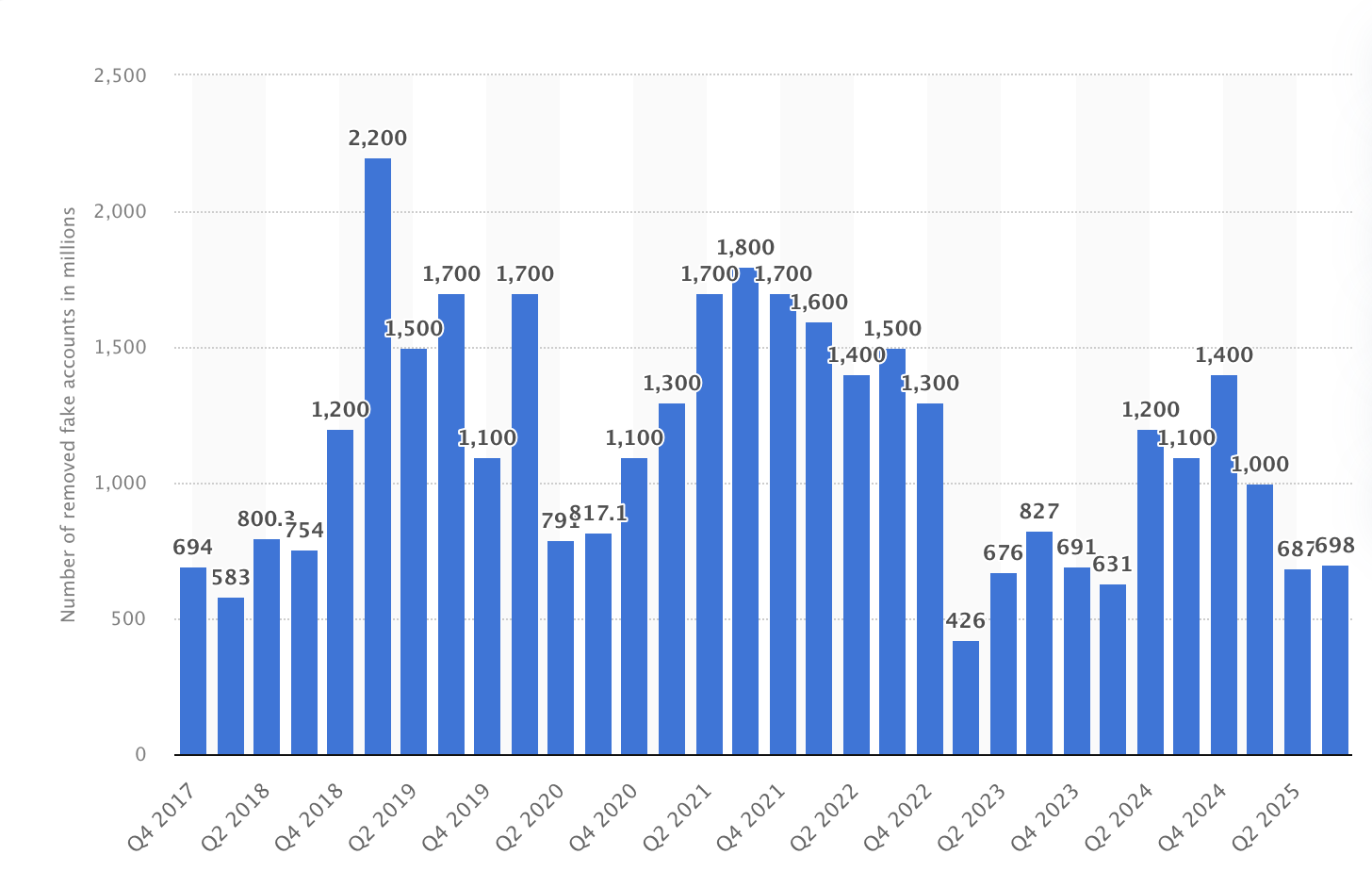
Number of removed fake accounts in millions
After PC verified, I can post now.