Demons Are Beasts Incapable of Communication
A reflection inspired by Frieren: when bots, sock puppets and scammers imitate human voices, what does trust online mean?
Frieren: “Demons only imitate human speech. In reality, they are beasts incapable of communication. Talking to them is pointless. Have you ever wondered why they use the same language as humans? To them, language is merely a tool to deceive.” Does this quote feel strangely familiar to you? Does it seem like Frieren is actually talking about the atmosphere of the internet? Have you noticed many entities online that appear human, but you’re not sure if they really are? What exactly are these “demons”?

Frieren: Beyond Journey’s End
Bots on Social Networks
There are many bots on social media. Some crawl data everywhere; some run their own pages—grabbing city restaurant photos, ratings, building audiences, capturing attention, and selling ads. Generally, bots don’t interact much with real people. Companies that publicly use bots don’t deceive the public, so these bots usually don’t need to engage with users. Bots that are heavily code-driven and not yet operated by humans cannot interact effectively with users. But interaction isn’t their business model anyway.
By this definition, would you consider bots “demons”?
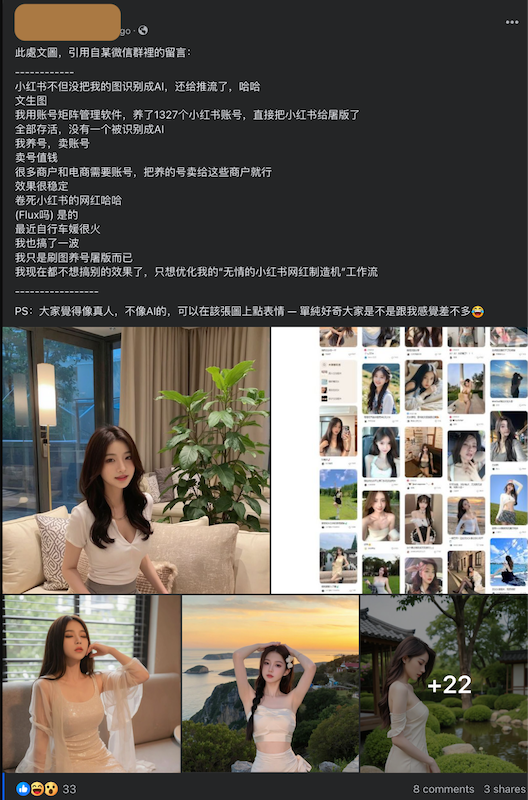
Murmur from bot operators on social networks
Controllers of Social Network Bots
A second category on social networks is harder to identify: fake accounts. The paper more vividly calls them—sock puppet accounts. These are usually operated by organized groups and used for various purposes. Their behavior mimics the reactions of large groups to specific events, including:
- Faking popularity for people or events (e.g., marketing)
- Influencing public opinion, politics, or elections
- Manipulating financial markets
- Drowning out other voices or deliberately creating conflict
- Spamming and propaganda at scale
Some typical traits of sock puppet accounts include: hiding their own content, following or gaining followers rapidly, or overusing certain tags. Since these accounts are operated by real people with specific intentions, they continue to evolve. And with AI-generated images, even profile photos can be artificially created, not just stolen—making it harder than ever to detect them.
So, let’s extend the definition a bit: any account that interacts online without being able to prove it’s really “you” is a sock puppet. By this definition, would you consider sock puppet accounts “demons”?
Control sock puppet accounts
Source: X
Fraudulent Accounts
The third kind of account on the internet is malicious and fraudulent. These are also fake accounts but with a different motive than sock puppets. Their intent is impersonation, phishing, or infiltration. They’ll impersonate roles to lure you in and engage in deep conversation. Their identity may be fake, but their professionalism can impress you, and their charm may win you over. Their sole goal is money—nothing else. Because money drives progress, this area evolves rapidly and professionally.
By this definition, do you consider scam accounts “demons”?
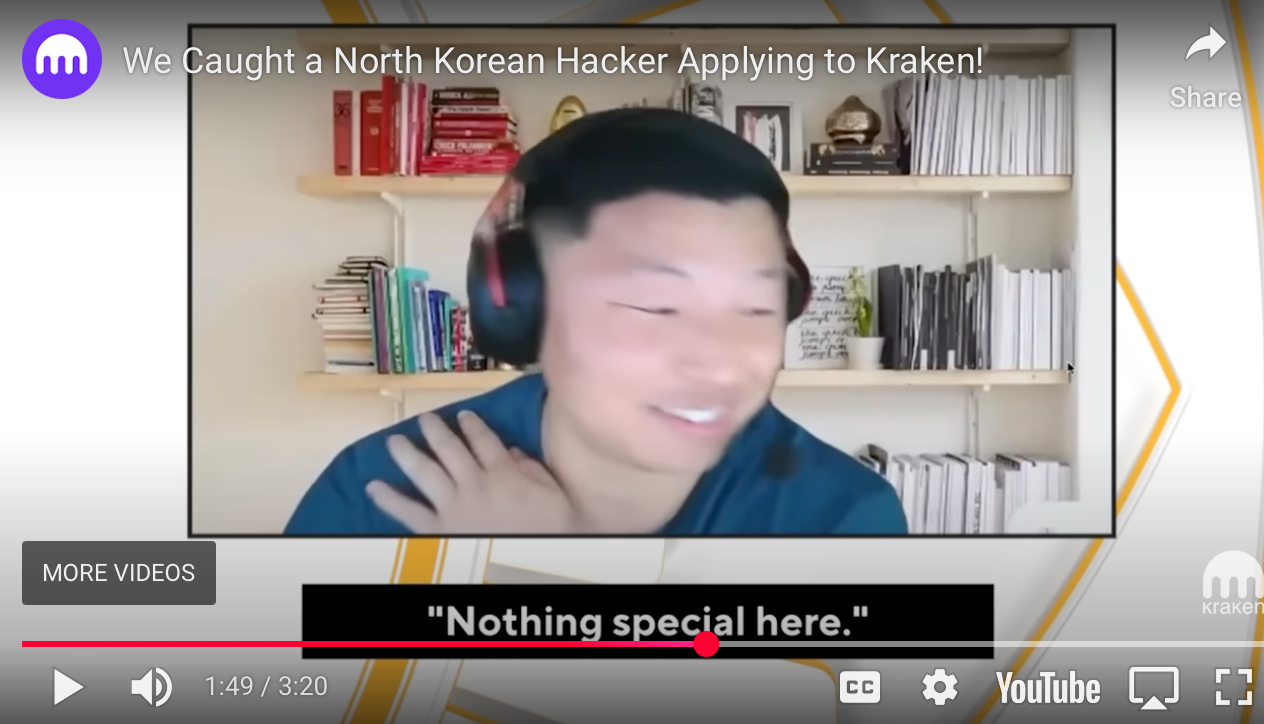
A North Korean hacker attempting to infiltrate Kraken by applying for a job
Source: Kraken
So What Can We Do?
To address this issue, the first step is to distinguish who is human and who is not.
A bot is not human—so if we can easily prove that we are human, we can indirectly conclude that “I am not a bot.” The simplest way is to use the phone’s built-in biometric verification to prove one’s humanity. If an account cannot even pass this basic verification, it lacks the minimum threshold of trust, and you should not believe anything it says.
This is the humanity credential.
While biometric verification raises the barrier for creating accounts, well-resourced organizations can still bypass it. This is where the passport comes in: one passport can only be linked to one account, further increasing its credibility. An account that can continuously maintain a verified passport binding can indirectly claim, “I am not a puppet account,” making it more trustworthy than an account verified only by biometrics.
This is the uniqueness credential.
Scam accounts, driven by financial incentives, are more likely to invest resources to gain access to a passport and create passport-bound accounts. Therefore, when engaging in financial or business transactions with unknown accounts, a credential proving identity based on a passport becomes an important trust factor—an essential piece of the puzzle for transaction security. A business account willing to reveal its identity is effectively stating, “I am not a scam account,” and is more credible than one merely bound to a passport.
This is the identity credential.